

.webp)
Articles
BYOD Security
BYOD security done right keeps organizational data off the device. See how Hypori's VMI architecture protects enterprise data without MDM.
BYOD Security: What It Is, How It Works, and Benefits
Bring Your Own Device (BYOD) enables employees to access organizational systems and resources using their personal devices. This approach enhances workforce flexibility but introduces significant security challenges that require a carefully architected solution.
What “Bring Your Own Device” Means in Modern Workplaces
In today’s IT landscape, BYOD refers to employees utilizing personal smartphones, tablets, or laptops to access enterprise systems, email, and virtual workspaces. While this expands flexibility and user convenience, it also broadens the attack surface for organizations. Without proper controls, corporate data can inadvertently reside on personal devices, creating risks of data leakage, especially when employees leave the company or devices are lost or stolen.
What Is BYOD Security?
BYOD security is an architectural approach combining policies, controls, and technology designed to mitigate risks associated with accessing sensitive enterprise data on personal devices. Traditional Enterprise Mobility Management (EMM) solutions provide oversight but do not fully address the core security challenges inherent in BYOD. EMM increases complexity and can expand the attack surface by requiring deep integration with personal devices.
Hypori’s virtual mobile infrastructure (VMI) addresses these challenges by shifting the workspace boundary away from the personal device and into a controlled environment. The personal device acts solely as a display and input surface, streaming pixels from the secure workspace and relaying user interactions back without any organizational data stored, processed, or cached on the endpoint.
Why BYOD Security Is Essential for Mobile-First Teams
Mobile endpoints—whether managed or unmanaged—are inherently vulnerable to malware, phishing, and unauthorized access. The diversity and complexity of mobile device ecosystems compound these risks. While EMM may reduce some vulnerabilities, it cannot eliminate the exposure caused by data residing on the device. Hypori’s VMI architecture assumes device compromise and ensures that organizational data does not reside on the personal device, preserving personal privacy by architecture and significantly reducing risk.
How BYOD Security Works
Effective BYOD security begins with a fundamentally different architecture. Instead of relying on securing the device itself, Hypori delivers a virtual mobile workspace inside a controlled environment. This workspace hosts all applications, data, processing, and identity management, while the personal device functions only as a display and input surface.
Access to the workspace is secured through strong authentication and encrypted channels. The architecture assumes device compromise, treating the personal device as an untrusted gateway. Only encrypted pixels are streamed to the device, and user inputs like keystrokes and touches are securely relayed back. No organizational data is ever stored on the personal device, and when a session ends, no organizational data remains on the endpoint.
Centralized control enables IT teams to enforce policies and updates inside the controlled environment, reducing the risk of data loss due to lost, stolen, or compromised devices. This approach supports BYOD without managing or intrusively controlling the personal device.
Step-by-Step BYOD Security Implementation
- User accesses a virtual workspace from their personal device
Employees use a client to connect to a virtual mobile workspace inside the controlled environment. The personal device acts as a display and input surface only.
- Authentication and secure connection are established
Strong authentication methods, including multifactor authentication (MFA), coupled with encrypted communication channels, ensure secure access. The architecture assumes device compromise and requires continuous verification.
- All processing happens inside the controlled environment
Applications and data run inside the virtual mobile workspace; the personal device does not process or store organizational data.
- Encrypted pixels are streamed to the device
Only visual information is transmitted; no actual organizational data leaves the controlled environment.
- Centralized control and zero data exposure reduce risk
IT manages security policies and updates inside the workspace boundary, with no organizational data stored on the endpoint.
These principles demonstrate how Hypori’s VMI shifts BYOD security from device-centric controls to a controlled, centralized environment, aligning with modern enterprise security requirements.
How Does BYOD Security Differ From Personal Device Security
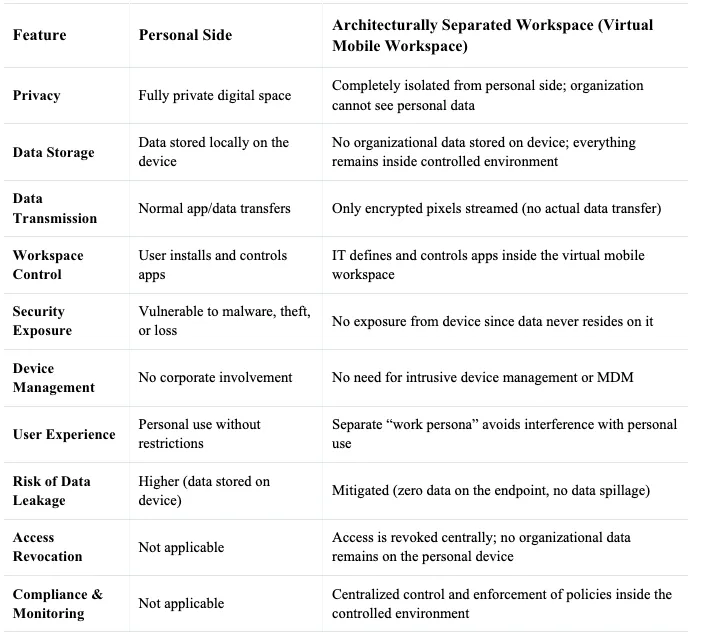
The fundamental distinction lies in where data resides: Hypori’s virtual mobile workspace ensures organizational data never lands on the personal device, preserving privacy and security by architecture.
How Security Policies Protect Personal Devices at Work
Effective BYOD governance establishes clear policies defining which users and devices can access organizational resources. These policies enable IT to enforce security standards, monitor access, and revoke workspace sessions centrally—without managing or wiping the personal device. This reduces vulnerabilities while respecting user privacy.
How Access Control, Authentication, and Encryption Reduce Risk
Strong access controls, modern authentication methods like MFA, and end-to-end encryption protect enterprise resources by preventing unauthorized access and safeguarding data in transit and at rest inside the controlled environment. Understanding the mobile threat landscape—including malware, phishing, and software vulnerabilities—is critical for tailoring policies that align with organizational risk tolerance.
The Role of Zero Trust Architecture in BYOD Security
Hypori’s architecture assumes device compromise, implementing continuous verification of users, devices, network conditions, and identities before granting or maintaining access to the virtual mobile workspace. This zero trust architecture reduces attack vectors and limits the blast radius of potential breaches by enforcing strict access controls within the controlled environment.
Key Benefits of BYOD Security
A well-implemented BYOD security program enhances data protection while preserving productivity and user privacy. By architecturally separating work from personal data, organizations can support workforce mobility without compromising security.
Stronger Mobile Security Without Limiting Productivity
Hypori’s virtual mobile infrastructure operates transparently, allowing employees to use familiar personal devices without exposing organizational data. This approach reduces training time and fosters user trust by preserving personal privacy by architecture.
Better Employee Flexibility and Lower Device Management Costs
By removing the need for device management or invasive controls, Hypori enables organizations to reduce hardware expenses and management overhead. One personal device effectively replaces two—supporting both personal use and secure access to enterprise resources without conflict.
Common BYOD Security Risks and Challenges
The primary challenge of BYOD is securing enterprise data on devices outside traditional network perimeters. Personal devices often have inconsistent security settings and run unvetted software, increasing the risk of data loss, malware infection, and unauthorized access.
Mobile applications selected by users vary widely, and IT lacks control over which apps are installed, creating potential vulnerabilities. Additionally, device patching and updates depend on user behavior, leaving gaps that attackers may exploit.
Privacy Concerns for Employees and Compliance Risks for Businesses
Balancing employee privacy with organizational security and regulatory requirements is critical. Overly intrusive controls can expose personal data, while insufficient security increases breach risk. Hypori’s architecture preserves personal privacy by design by ensuring no organizational data is stored or processed on personal devices, helping to reduce compliance scope and protect sensitive information.
Core Elements of Effective BYOD Security
Effective BYOD security combines security best practices, continuous user education, layered defenses, and ongoing risk management. This holistic approach reduces the likelihood and impact of security incidents while maintaining operational continuity.
Mobile Device Management and Mobile Application Management
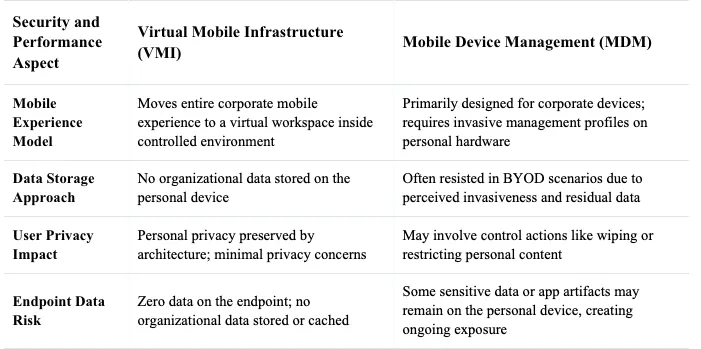
While MDM and MAM frameworks provide policy enforcement on devices, they increase architectural complexity and require deep device integration. They rely on the integrity of hardware that is outside organizational control in BYOD scenarios. Hypori’s VMI supports BYOD security without requiring MDM, aligning with controlled-environment requirements and preserving user privacy.
BYOD Policies, User Training, and Secure Access Controls
Strong BYOD governance includes clear policies, user security awareness training, and secure access controls that help users identify social engineering attempts and adhere to security best practices.
How VMI Technology Supports BYOD Security
Hypori’s virtual mobile infrastructure supports BYOD security by moving the entire workspace boundary into a controlled environment. This architecture eliminates organizational data storage on personal devices, reducing local exposure and simplifying security management.
What is Virtual Mobile Infrastructure (VMI)
VMI is a virtual mobile workspace hosted inside a controlled environment where the mobile operating system and corporate workloads run. Users access this workspace from personal devices that act solely as display and input surfaces. Organizational data and applications remain architecturally separated from the personal device, ensuring zero data on the endpoint.
How VMI Improves Data Protection on Personal and Mobile Devices
By ensuring no organizational data resides on the personal device, VMI minimizes data-at-rest risks common in traditional BYOD deployments. The Hypori architecture assumes device compromise, centralizing risk into a hardened, monitored controlled environment and preventing data spillage.
VMI vs MDM for Secure BYOD Environments
When Businesses Should Use BYOD Security Solutions
Organizations should implement BYOD security solutions as soon as employees use personal devices to access enterprise systems, especially in sectors with increasing cyber threats and stringent regulatory requirements. Early adoption reduces risk and supports secure workforce mobility.
Teams, Industries, and Use Cases That Benefit Most from BYOD Security
Industries such as healthcare, finance, legal, field services, and distributed sales benefit significantly from BYOD security. These sectors handle sensitive data, operate in highly regulated environments, and require secure, remote access without compromising privacy or data protection. Hypori’s virtual mobile infrastructure enables secure virtual access to enterprise resources without storing organizational data on personal devices, making it ideal for mobile and distributed teams.
Hypori: BYOD Security
Hypori is a trusted BYOD Security solution for defense, government, and enterprise organizations. Our solution delivers a secure virtual mobile workspace designed specifically for Bring Your Own Device programs, aligning with controlled-environment requirements while preserving user privacy by architecture.
Learn more about our Hypori product designed as a secure virtual workspace solution for BYOD programs. Request BYOD Security Demo